


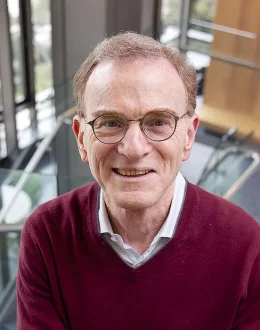
Randy Schekman keynote speaker
- Cracking the Cell's Postal System: The Science behind a Nobel Prize
- From Yeast to Medicine: How Fundamental Research Shapes the Future
- Inside the Race to Understand Parkinson's Disease
- The Open Science Revolution: Why Research Belongs to Everyone
Randy Schekman is a 2013 Nobel Laureate in Physiology or Medicine whose discoveries transformed our understanding of how cells organize and execute the transport of proteins — one of the most fundamental processes in biology. A Professor in the Department of Molecular and Cell Biology at the University of California, Berkeley, and a longtime Investigator at the Howard Hughes Medical Institute, Schekman has spent decades mapping the molecular machinery that governs how cells package, move, and secrete proteins with extraordinary precision.
Nobel Prize speaker Randy Schekman shared the 2013 Nobel Prize with James Rothman and Thomas Südhof for their collective work decoding the vesicle trafficking system — the intricate network of membrane-bound sacs that ferry proteins to the right cellular compartments at the right time. Schekman’s contribution was foundational: using baker’s yeast as a model organism, he identified the genes responsible for regulating vesicle transport, demonstrating that mutations in these genes cause traffic jams within the cell with severe biological consequences. His work established a genetic blueprint for the secretory pathway that has since proven conserved across all eukaryotic life, including humans.
His research laid the scientific groundwork for understanding diseases caused by defects in protein transport, and has informed the biotechnology industry’s use of yeast to manufacture clinically vital proteins such as recombinant human insulin. Among his many honors are the Albert Lasker Award for Basic Medical Research, the Gairdner International Award, the Louisa Gross Horwitz Prize of Columbia University, and election to the National Academy of Sciences.
Beyond the laboratory, Schekman has become one of science’s most outspoken advocates for open access publishing. As founder and inaugural Editor-in-Chief of eLife, the high-profile open-access journal backed by the Howard Hughes Medical Institute, the Wellcome Trust, and the Max Planck Society, he championed a model of scientific communication that prioritizes rigor over prestige metrics. He also served as Editor-in-Chief of the Proceedings of the National Academy of Sciences. In 2018, he took on the role of Scientific Director of Aligning Science Across Parkinson’s (ASAP) — a globally coordinated research initiative partnered with The Michael J. Fox Foundation — now spanning 35 teams across 165 laboratories worldwide, focused on uncovering the molecular origins of Parkinson’s disease.
As a speaker, Randy Schekman brings the rare combination of Nobel-level scientific authority and genuine accessibility to audiences spanning healthcare, biopharma, research institutions, and corporate innovation. His talks translate landmark cell biology into broader lessons about curiosity-driven research, the structures that enable scientific breakthroughs, the politics of academic publishing, and the future of disease research. Senior audiences gain not only scientific insight but a compelling model for how patient, rigorous inquiry — seemingly far from clinical relevance — can yield discoveries that reshape medicine and industry alike.



* and we really do it immediately