


Kip Thorne: Exploring the Universe’s Greatest Mysteries
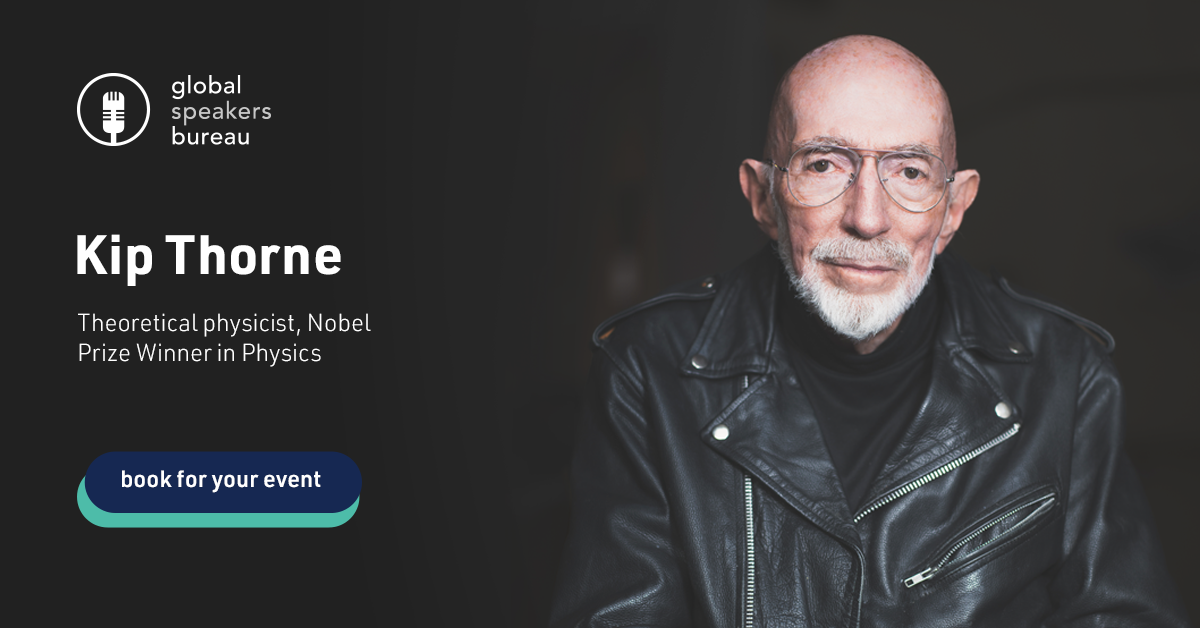
Few scientists have done more to shape our understanding of the universe than Dr. Kip Thorne. Nobel Prize-winning physicist, former Feynman Professor of Theoretical Physics at the California Institute of Technology (Caltech), pioneer of gravitational wave astronomy, and one of the world's leading experts on black holes and spacetime, Dr. Thorne has spent decades exploring some of the most profound questions in science. His work has helped transform ideas that once belonged almost exclusively to theoretical physics into topics discussed far beyond the scientific community.
Today, black holes, gravitational waves, wormholes, and the origins of the universe are part of mainstream curiosity. They appear in films, documentaries, school lessons, and public conversations about the future of science. Yet many of these ideas were shaped by decades of rigorous research from physicists such as Dr. Thorne and his colleagues. What makes his career especially compelling is not only the importance of his discoveries, but the way he moves between deep scientific complexity and public imagination. He helps audiences understand that the universe is not just something to observe from a distance, but something we are still learning how to question.
Hearing the Universe for the First Time
One of the defining achievements of Dr. Thorne's career was his role in the detection of gravitational waves. For nearly a century, these ripples in spacetime existed only as a prediction of Albert Einstein's theory of general relativity. Scientists believed they should exist, but proving their existence required instruments capable of measuring changes smaller than anything previously attempted. By the time a gravitational wave reaches Earth, its effect is incredibly small, making detection one of the most ambitious challenges in modern physics.
Working alongside colleagues including Rainer Weiss and Barry Barish, Dr. Thorne became one of the key figures behind LIGO, the Laser Interferometer Gravitational-Wave Observatory. The project required decades of persistence and the collaboration of thousands of scientists, engineers, and researchers. Then, on September 14, 2015, a signal passed through the detectors. It had travelled more than a billion light-years, created by the collision of two black holes. For the first time in history, humanity had directly detected gravitational waves. The achievement earned Dr. Thorne and his colleagues the 2017 Nobel Prize in Physics, but its meaning went far beyond the award. It opened an entirely new way of studying the cosmos, allowing scientists to observe events that traditional telescopes could never reveal.
Black Holes and the Limits of Imagination
Long before gravitational waves entered public awareness, Dr. Thorne had already established himself as one of the world's leading authorities on black holes. Today, black holes are among the most recognizable objects in science, but for much of the twentieth century they remained mysterious, controversial, and difficult to understand. Dr. Thorne's research helped clarify how matter behaves near black holes, how gravity distorts space and time, and why these objects are central to understanding the most extreme conditions in the universe.
The fascination with black holes comes from the way they challenge everyday intuition. Near a black hole, time slows down, light bends, and space itself becomes warped. These are not poetic metaphors, but consequences of the physics describing gravity. For audiences, this is where Dr. Thorne's work becomes especially powerful. He does not simply explain black holes as strange objects in space. He uses them to show how reality can be far more surprising than common sense suggests. His work reminds us that science often begins when we are willing to question what seems obvious.
Interstellar and the Power of Scientific Storytelling
Many people who may never read a scientific paper encountered Dr. Thorne's work through Interstellar. Serving as executive producer and scientific advisor, he worked closely with director Christopher Nolan to ensure that the film remained grounded in real physics wherever possible. The result was one of the most scientifically ambitious films ever produced, where concepts such as time dilation, black holes, gravity, and wormholes were not decorative elements added for realism, but central parts of the story itself.
One of the film's most memorable achievements was Gargantua, the supermassive black hole at the center of the film. Its appearance was generated using calculations based on Einstein's equations, creating one of the most scientifically accurate visualizations of a black hole ever shown on screen. The collaboration demonstrated something important about science communication: audiences are often willing to engage with complex ideas when those ideas are presented through strong storytelling. Interstellar did not make physics easy, but it made millions of people curious about it. For Dr. Thorne, this kind of work reflects a broader belief that science and creativity are not opposites. Both require imagination, discipline, and a willingness to explore the unknown.
From Equations to Art
One of the most surprising aspects of Dr. Thorne's career is that some of his most influential work has happened outside traditional academia. After nearly five decades at Caltech, where he became one of the world's leading experts on relativity, black holes, and astrophysics, he gradually expanded his focus beyond research and teaching. In recent years, he has collaborated with musicians, visual artists, filmmakers, and writers to explore new ways of communicating scientific ideas.
This shift does not represent a departure from science, but an extension of it. Dr. Thorne has worked on projects involving film, music, poetry, painting, and multimedia performance, all with the goal of helping broader audiences experience ideas about warped spacetime and the universe. These collaborations reflect his belief that knowledge becomes more powerful when it can be shared across disciplines. For event audiences, this makes his perspective especially relevant. He brings not only the authority of a Nobel Prize-winning physicist, but also the curiosity of someone who understands that the biggest ideas often need more than equations to be fully appreciated.
The Questions Still Ahead
Despite spending much of his career studying black holes and gravitational waves, the question that fascinates Dr. Thorne most today is the birth of the universe itself. He has spoken about the possibility that future gravitational-wave observations may help scientists understand the earliest moments of cosmic history. Unlike light, which cannot travel freely through the dense conditions of the early universe, gravitational waves may carry information from regions that remain inaccessible to traditional telescopes. If detected, primordial gravitational waves could offer clues about the Big Bang, the laws of quantum gravity, and perhaps even what came before the beginning of the universe as we understand it.
This is what makes Dr. Thorne such a compelling voice for audiences today. He does not present science as a finished collection of answers, but as an ongoing exploration where each discovery creates deeper questions. His career reflects the value of persistence, imagination, and intellectual courage. From gravitational waves to black holes, from Interstellar to the future of cosmic discovery, Dr. Thorne helps audiences see science not as something remote or abstract, but as one of humanity's greatest efforts to understand reality.